Tag: Badger Clark

Discover Badger Clark by slam poets, cowboy poets, and literary giants inspired by the state of Arizona on AZpoetry.com!

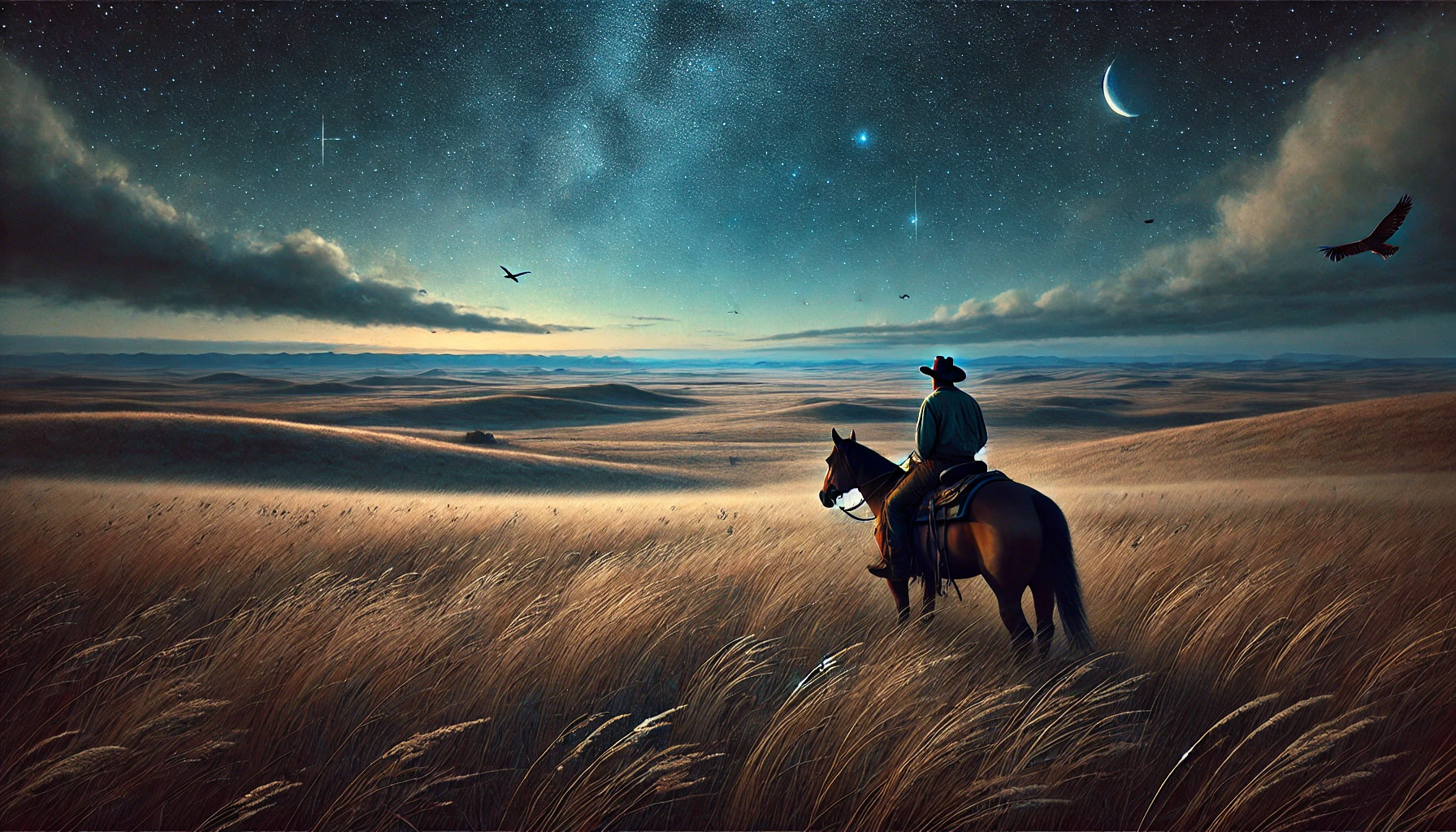
Ridin by Badger Clark artwork AZpoetry.com

Ridin’ by Badger Clark

“Ridin'” by Badger Clark

There is some that like the city—
    Grass that’s curried smooth and green,
Theaytres and stranglin’ collars,
    Wagons run by gasoline—
But for me it’s hawse and saddle
    Every day without a change,
And a desert sun a-blazin’
    On a hundred miles of range.

    Just a-ridin’, a-ridin’—
        Desert ripplin’ in the sun,
    Mountains blue among the skyline—
        I don’t envy anyone
            When I’m ridin’.

When my feet is in the stirrups
   And my hawse is on the bust,
With his hoofs a-flashin’ lightnin’
   From a cloud of golden dust,
And the bawlin’ of the cattle
   Is a-comin’ down the wind
Then a finer life than ridin’
   Would be mighty hard to find.

    Just a-ridin’, a-ridin’—
        Splittin’ long cracks through the
            air,
    Stirrin’ up a baby cyclone,
        Rippin’ up the prickly pear
            As I’m ridin’.

I don’t need no art exhibits
    When the sunset does her best,
Paintin’ everlastin’ glory
    On the mountains to the west
And your opery looks foolish
    When the night-bird starts his tune
And the desert’s silver mounted
    By the touches of the moon.

    Just a-ridin’, a-ridin’—
        Who kin envy kings and czars
    When the coyotes down the valley
        Are a singin’ to the stars,
            If he’s ridin’?

When my earthly trail is ended
    And my final bacon curled
And the last great roundup’s finished
    At the Home Ranch of the world
I don’t want no harps nor haloes
    Robes nor other dressed up things—
Let me ride the starry ranges
    On a pinto hawse with wings!

    Just a-ridin’, a-ridin’—
        Nothin’ I’d like half so well
    As a-roundin’ up the sinners
        That have wandered out of Hell,
            And a-ridin’    

About the poet Badger Clark

Summary and Analysis of “Ridin’” by Badger Clark (1922)

Badger Clark’s iconic poem “Ridin’,” first published in 1922, is a quintessential piece of American cowboy poetry that celebrates the untamed beauty of the West and the profound sense of freedom found in a life spent on horseback. Known for his vivid imagery and rhythmic lyricism, Clark paints a portrait of a cowboy’s existence—marked by wide-open landscapes, blazing sun, and the unshakable joy of “just a-ridin’.”


A Tribute to the Cowboy Life

The poem contrasts two ways of life: the modern, urban environment filled with “theaytres,” “wagons run by gasoline,” and “grass that’s curried smooth and green,” versus the raw, natural life of a cowboy. Clark rejects the luxuries and constraints of city life in favor of the harsh yet freeing reality of the range, where the sun scorches the horizon and one’s world stretches “a hundred miles” wide.

The repeated refrain—“Just a-ridin’, a-ridin’”—becomes a musical echo throughout the poem, reinforcing the spiritual simplicity and joy that comes from this nomadic lifestyle.


Wild Beauty and Rugged Romance

Each stanza highlights the elements of cowboy life that make it so appealing: the thrill of galloping across desert terrain, the natural artistry of a sunset, and the haunting songs of coyotes in the valley. Clark makes a compelling case for the cowboy as both adventurer and artist—one who finds meaning not in galleries or opera houses, but in the ever-shifting canvas of the sky and land.

The poem pulses with movement: horses “on the bust,” “hoofs a-flashin’ lightnin’,” and “long cracks through the air.” It’s kinetic, full of dust and thunder, but never chaotic. The landscape isn’t a backdrop—it’s a participant in the cowboy’s journey.


Spiritual Frontier

In the final stanza, Clark leans into the metaphysical, imagining his afterlife not with harps and halos, but with a “pinto hawse with wings” riding across “the starry ranges.” Even in eternity, the poet’s heaven is a wide-open range—where he can “round up sinners” with the same fierce joy he rode with on earth.

This blend of cowboy grit and spiritual longing places “Ridin’” in the tradition of American transcendental poetry, akin to Whitman’s celebration of the self and nature. But where Whitman wandered the forests, Clark’s domain is the high desert and the open plains.


A Lasting Voice of the West

“Ridin’” remains a definitive cowboy poem because it captures the soul of Western life—rugged, free, and unbound by convention. Its charm lies in both its musicality and its reverence for a vanishing way of life. In an era that was already becoming more industrial and urban, Badger Clark reminded readers that there’s still magic in a lone rider under a big sky.

Want to learn more about the poet who gave voice to the Western range?
Visit Badger Clark’s poet bio page on AZPoetry.com and explore his legacy as one of America’s original cowboy poets.
A Cowboy's Prayer poem by Badger Clark | AZpoetry.com

“A Cowboy’s Prayer” by Badger Clark

A Cowboy’s Prayer

(Written for Mother)

Oh Lord, I’ve never lived where churches grow.
I love creation better as it stood
That day You finished it so long ago
And looked upon Your work and called it good.
I know that others find You in the light
That’s sifted down through tinted window panes,
And yet I seem to feel You near tonight
In this dim, quiet starlight on the plains.

I thank You, Lord, that I am placed so well,
That You have made my freedom so complete;
That I’m no slave of whistle, clock or bell,
Nor weak-eyed prisoner of wall and street.
Just let me live my life as I’ve begun
And give me work that’s open to the sky;
Make me a pardner of the wind and sun,
And I won’t ask a life that’s soft or high.

Let me be easy on the man that’s down;
Let me be square and generous with all.
I’m careless sometimes, Lord, when I’m in town,
But never let ’em say I’m mean or small!
Make me as big and open as the plains,
As honest as the hawse between my knees,
Clean as the wind that blows behind the rains,
Free as the hawk that circles down the breeze!

Forgive me, Lord, if sometimes I forget.
You know about the reasons that are hid.
You understand the things that gall and fret;
You know me better than my mother did.
Just keep an eye on all that’s done and said
And right me, sometimes, when I turn aside,
And guide me on the long, dim, trail ahead
That stretches upward toward the Great Divide.

About the poet Badger Clark

“A Cowboy’s Prayer” was originally written and published in the 1910s by Badger Clark. The poem explores the poet’s musings on faith, career, and landscape as pillars of American life. Learn more about the poet HERE.

Badger Clark

Badger Clark (Charles Badger Clark Jr.) was born on January 1, 1883, in Albany, Iowa, and became one of the most iconic voices in American Western poetry. Though he is most commonly associated with South Dakota, where he served as the state’s poet laureate for many years, Clark spent a significant amount of time in the American Southwest, including Arizona, where the rugged landscapes and cowboy culture deeply influenced his work. Known for his ability to capture the spirit of the frontier, Clark’s poetry resonates with themes of freedom, nature, and the life of a cowboy, all expressed in a simple yet vivid style.

Early Life and Inspiration

Badger Clark grew up in Deadwood, South Dakota, where he was introduced to the rugged lifestyle of the West from a young age. After studying at Deadwood High School, he attended Dakota Wesleyan University but left due to poor health. In search of a better climate, Clark ventured to Arizona, where he found solace in the open skies and desert landscapes. It was here, in the remote areas of the Southwest, that Clark began writing poetry as a way to express his connection to the land and its people.

During his time in Arizona, Clark took up the cowboy lifestyle, working as a ranch hand and living in rustic cabins. These experiences profoundly shaped his poetic voice and provided him with the material that would later make him a celebrated figure in Western literature.

Literary Career

Clark’s first collection, “Sun and Saddle Leather” (1915), captured the essence of the cowboy way of life and earned him widespread acclaim. This collection includes some of his most famous poems, such as “A Cowboy’s Prayer” and “The Glory Trail”, which portray the cowboy as both a romantic and rugged figure, living harmoniously with nature and embracing the challenges of life on the frontier.

In “A Cowboy’s Prayer“, Clark uses simple language and a conversational tone to reflect the cowboy’s spiritual connection to the land. This poem, along with others, helped establish Clark as a voice for the Western lifestyle, celebrating the independence, resilience, and spirituality of those who lived close to the land. His poetry often employs humor, humility, and a reverence for nature, qualities that resonated with audiences who appreciated his authentic portrayal of Western life.

Time in Arizona and Influence

Although Clark is often associated with South Dakota, his years in Arizona were instrumental in shaping his poetic sensibilities. The beauty of the Arizona desert, the wide-open spaces, and the cowboy culture all found their way into his poetry, adding a Southwestern flavor to his work. His time in Arizona allowed him to fully experience the cowboy lifestyle, and this immersion lent a deep authenticity to his writing. The Southwest’s vast and rugged landscapes inspired his contemplative verses, which often explore themes of freedom, isolation, and a deep connection to nature.

Clark’s experiences in Arizona also introduced him to Hispanic and Native American cultures, which subtly influenced his perspective on life in the American West. His ability to portray the diverse aspects of Western life and his respect for the land and its people have made his work enduringly popular.

Later Life and Legacy

After returning to South Dakota, Clark continued to write and publish poetry, becoming one of the most celebrated Western poets of his time. In 1937, he was appointed Poet Laureate of South Dakota, a title he held until his death. Despite his relocation, Clark’s poetry remained infused with the spirit of the Southwest, capturing the essence of both the Arizona desert and the Northern plains.

Badger Clark passed away on September 26, 1957, in Hot Springs, South Dakota, but his work lives on as a testament to the Western experience. His poetry has been included in anthologies of American literature and continues to be celebrated by readers who admire his portrayal of cowboy life and his love for the Western landscape.

Legacy in Western and Cowboy Poetry

Badger Clark’s work laid the foundation for what would become the cowboy poetry tradition, inspiring future generations of poets to explore themes of independence, resilience, and nature. His poems continue to be read and appreciated by audiences around the world, and his influence is evident in the work of contemporary cowboy poets. His poems, which are often recited at cowboy poetry gatherings and Western heritage events, capture the spirit of the American West in a way that few others have.

In Arizona, Clark’s legacy is cherished as part of the state’s own rich tapestry of Western culture. His time spent in Arizona helped shape his perspective and brought a Southwestern essence to his work, ensuring that his poetry resonates deeply with the landscapes and lifestyles of both the Southwest and the Great Plains.

Today, Badger Clark is remembered not only as a poet but as a cultural icon who immortalized the cowboy spirit through his verse. His works, such as “Sun and Saddle Leather” and “Sky Lines and Wood Smoke,” continue to capture the imaginations of those drawn to the frontier and remain a beloved part of Western literary heritage.

Discover more significant poets who have been inspired by Arizona HERE.